How To Category - Progressive Automations Blog

How to Overcome Mechanical Noise when Operating a Linear Actuator
When operating linear actuators, there are many product specifications which users need to understand. Some examples of the actuator specifications that are important may include speed, force, current draw, and dimensions. There is however one element of a linear actuator that can be tricky to gauge, the noise level. Many users often won’t know for sure the ideal noise levels or restrictions until their application with linear actuators are ru...
Read More
How to Overcome Mechanical Noise when Operating a Linear Actuator

How To Choose Best TV Lift Mechanism
The most recent addition to our line of TV automation products is the TY-05 drop-down TV lift. The unit is designed to be installed as a drop down TV from the ceiling or against the wall. This lift is operated using a wireless remote and can raise your TV to hide it from plain sight and lower it when needed. In this article, we will discuss how to select the best TV lift mechanism for your application.
[cta] [cta-content]
Find your perfect au...
Read More
How To Choose Best TV Lift Mechanism
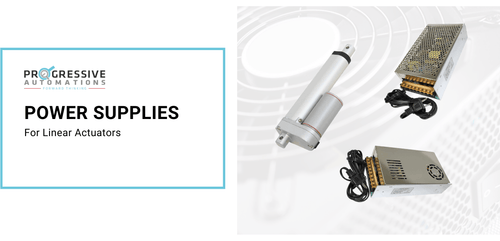
How to Pick the Right Power Supply for Your Linear Actuator
It is very important to pick the right power supply for your electric linear actuator. You can have the perfect application design, the best actuator for your need, and a flawless mounting setup, but without choosing the right power supply your system will not function. In this article, we will be going over a few important points on how to choose a power supply for your linear actuator.
[cta] [cta-content]
Browse through our range of linear ac...
Read More
How to Pick the Right Power Supply for Your Linear Actuator

How to Read the Signal from a Hall Effect Sensor Using an Arduino
Hall effect sensors are one of the feedback options we offer in our linear actuators to provide position and speed information. Our PA-04-HS and PA-100 have Hall effect sensors on the stock units. While several of our other actuators can be custom ordered with Hall effect sensors.
[cta] [cta-content]
Browse our range of Arduino microcontrollers for ultimate actuator control!
Browse Arduino
[cta]
WHAT IS A HALL EFFECT SENSOR?
A Hall effect sens...
Read More
How to Read the Signal from a Hall Effect Sensor Using an Arduino

Using Relays for 24 VDC Systems to Work with 12 VDC Actuators
Have you ever faced a situation where you must connect a lower voltage actuator with a higher voltage control unit, or wondered about the compatibility of a 24-volt relay for a 12-volt actuator? We offer the PA-VC1 for converting 12 VDC into 24 VDC, however, this device is unable to convert 24 VDC into 12 VDC. Most of our in-stock actuators are available with 12 VDC motors and would not be directly compatible with 24 VDC signals or power. Cust...
Read More
Using Relays for 24 VDC Systems to Work with 12 VDC Actuators

How To Use Our Actuators with an Arduino and MegaMoto
Arduino microcontrollers are perfect for controlling a Progressive Automations linear actuator. However, like most microcontrollers, it has pin input/output current limitations. If these limitations are exceeded, it can cause instant and permanent damage to the Arduino, especially when operating a high-powered industrial linear actuator. Even a micro or mini linear actuator could be too much for the Arduino to power directly.
The solution is t...
Read More
How To Use Our Actuators with an Arduino and MegaMoto