-
Motorized TV Lift - 32" - 60" TVs - 25.4" Stroke
Model TY-01-25R 7,055.00 ZAR -
Motorized TV Lift - 32" - 60" TVs - 38.8" Stroke
Model TY-01R 7,219.00 ZAR -
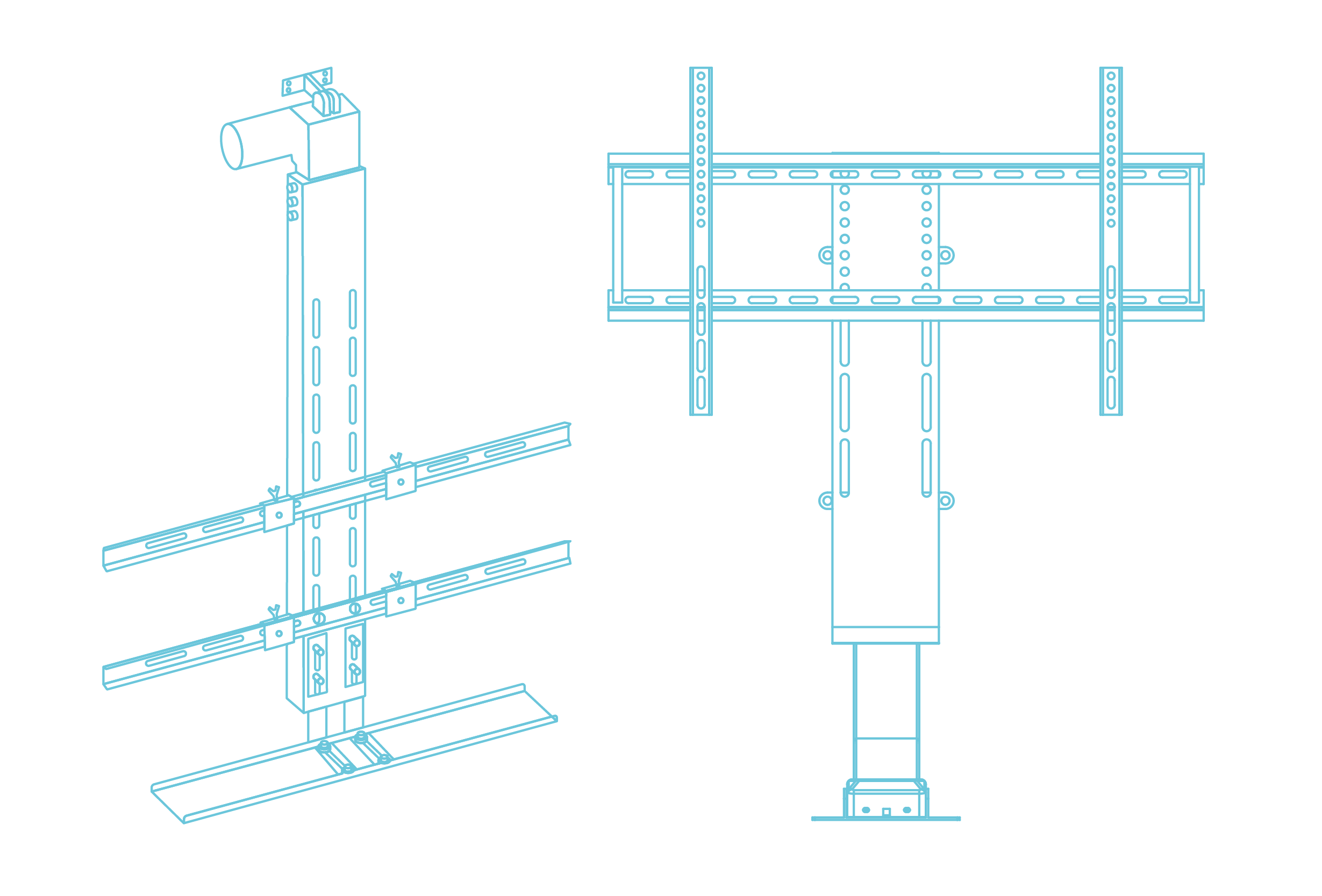
Drop Down TV Lift: Up to 55" TVs
Model TY-05-30R 9,844.00 ZAR -
Drop Down TV Lift: Up to 75" TVs
Model TY-05-40R 10,270.00 ZAR -
Drop Down TV Lift: Up to 95" TVs
Model TY-05-50R 10,598.00 ZAR


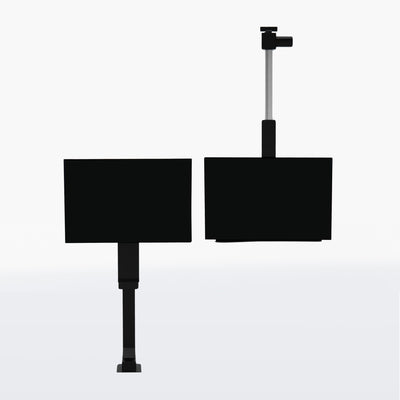
A motorized ceiling TV mount stores the screen above the ceiling line and lowers it to a precise viewing height on command. When retracted, the installation is completely clean: no visible hardware, no exposed cables, no screen. When activated, the mechanism descends in a single controlled motion and locks at the programmed position.
PA's ceiling mount TV lift systems use lifting columns in an inverted configuration. The same Hall-effect sensor system used in PA's standing desk and table lift range keeps every column synchronised throughout the travel cycle, preventing the screen from tilting or binding during descent.
A motorized ceiling drop-down TV mount uses one or two lifting columns mounted above the ceiling, anchored to the structural framing above. The columns extend downward to lower the screen and retract fully to conceal it. The travel distance between stored and viewing positions is set using the remote's memory function and the mechanism returns to the exact same position every cycle.
Stroke lengths from 16 to 56 inches accommodate different ceiling heights and installation depths. The FLTCON-2 control box handles dual-column drop-down configurations, maintaining synchronisation between columns even under uneven screen weight distribution.
Anti-collision protection is active throughout the full travel range. If the mechanism encounters resistance during descent or ascent, the control box immediately stops and reverses direction.
A retractable ceiling TV lift retracts the screen completely flush with the ceiling surface when not in use. Unlike a standard ceiling drop-down mount that hangs the screen below the ceiling at all times, a retractable system hides the mechanism inside a housing above the ceiling cutout and the screen is invisible at rest.
The columns retract to their minimum height, pulling the screen up into the housing and leaving only the flush panel visible from below. This configuration is used in living rooms, master bedrooms, home theatres, and hospitality spaces where aesthetics require zero visible hardware.
PA's retractable TV lift configurations use the same FLTCON control boxes and RT-series remotes as the standard drop-down range. The key specification to confirm is the minimum retracted height of the column, which must fit within the ceiling void above the installation cutout. Contact PA engineering at 1-800-676-6123 with your ceiling void depth and screen weight to get the correct column specification.
A hidden ceiling TV mount configuration conceals not just the screen but the entire mechanism inside a ceiling housing or recessed enclosure. The panel above the screen position is either a hinged flush door that opens as the mechanism descends, or a fabric-covered frame that the screen passes through on extension.
These installations require coordination between the lift mechanism stroke, the housing dimensions, and the TV's own thickness and bracket mount. PA supplies the lift mechanism and control system. The housing enclosure is typically custom-built to the installation space.
Multi-column configurations, either 2 or 4 columns from a single FLTCON control box, provide the stability needed for larger screens in hidden ceiling installations. Column spacing is adjustable to clear the TV's own mounting bracket and allow the screen to pass cleanly through the ceiling opening.
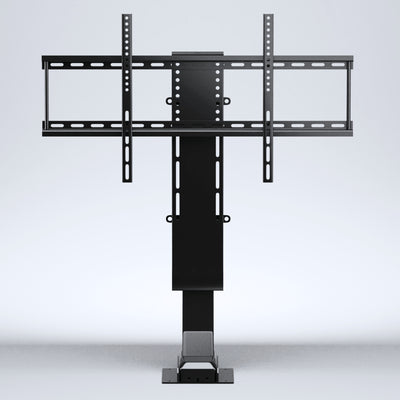
A pop-up TV lift pushes the television vertically upward through an opening, rising from inside a furniture piece, an ottoman, a floor housing, or a purpose-built enclosure. The mechanism retracts fully when not in use, leaving the installation flush and clean. At the press of a button, the screen rises to the stored height position and locks in place.
PA's electric pop-up TV lift mechanisms use the same actuator-powered lifting columns as the ceiling mount range. The columns extend to raise the screen and retract to lower it. One, two, or four columns can be controlled from a single FLTCON control box, with each column's position tracked independently by its Hall-effect sensor system.
An electric pop-up TV lift uses a DC motor to extend and retract the lifting column, converting electrical power into vertical linear motion. The user presses a button on the remote, the control box reads the current column position from the Hall-effect sensors, calculates the distance to the target preset position, and drives the motor accordingly.
The mechanism stops automatically at the preset position and will not over-travel. If an obstruction is detected, such as the lid of an enclosure that did not open fully or an object placed on top of the screen housing, anti-collision protection stops and reverses the column before damage occurs.
Dual-column electric pop-up configurations keep the screen level throughout the full travel range. Without synchronised columns, a screen mounted on a single central column can tilt under off-centre weight from the TV's own mass and attached cables. PA's FLTCON control boxes actively correct for speed differences between columns throughout the stroke.
In-floor TV lift applications house the mechanism below the finished floor surface, with the screen emerging through a floor-level panel when activated. These installations require longer-stroke columns, typically 32 to 56 inches, to raise the screen from below floor level to a comfortable standing or seated viewing height.
Furniture pop-up TV lifts are installed inside an ottoman, sideboard, media unit, or purpose-built enclosure. The column stroke needs to match the internal cabinet depth plus the rise distance above the opening. Measure from the base of the column mounting point to the top of the screen position at full extension. This is the required stroke length.
For both in-floor and furniture pop-up applications, the minimum footprint of the column base determines the available clearance inside the enclosure. PA's LG-series modular lifting columns are the recommended choice for space-constrained installations. They can be configured as single units paired with the FLTCON-1 control box, or grouped in multi-column configurations up to four columns from a single FLTCON-4 controller.
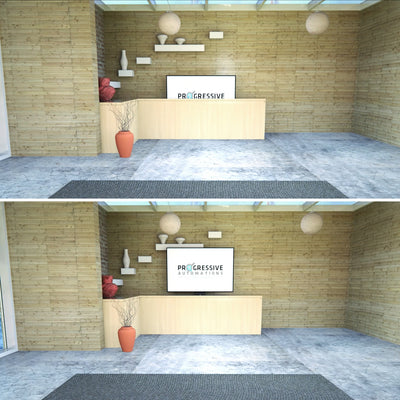
A ceiling drop-down TV mount uses lifting columns mounted in an inverted position above the ceiling line. When activated, the columns extend downward, lowering the screen to a pre-programmed viewing height. The FLTCON control box keeps all columns synchronised throughout the descent, so the screen travels straight and level regardless of uneven weight distribution. When retracted, the columns pull the screen back above the ceiling and hold position without power.
PA TV lift mechanisms are rated from 180 lbs (single-column) to 880 lbs (four-column). The rating covers the total moving load: TV, mounting bracket, cables, and any additional hardware attached to the lift carriage. For regular use, stay within 80% of the rated capacity. For loads above 880 lbs, contact PA engineering at 1-800-676-6123 to discuss a custom multi-column solution.
A motorized TV mount tilts, swivels, or extends a screen from a fixed wall or ceiling anchor point using small actuators over short distances, typically 2 to 12 inches of movement. A TV lift mechanism moves the entire television vertically over a significant travel distance, from 16 to 56 inches, using full-size lifting columns. TV lift mechanisms are used when the screen needs to disappear completely: above the ceiling line, inside a furniture piece, or below floor level.
Measure the distance from where the column base will be mounted to the lowest position the screen needs to reach at full extension. For ceiling drop-down installations, this is the distance from the ceiling surface to the bottom viewing position. For pop-up installations, this is the rise distance from the base plate to the screen at full extension. Order a column with a stroke equal to or greater than this measurement. Available strokes: 16, 20, 25, 32, 40, 50, and 56 inches.
Selected PA lifting columns carry IP43 and IP54 ratings and are suitable for covered outdoor environments such as covered patios, outdoor entertainment spaces, or roofed commercial terraces. For direct exposure to rain, salt air, or extreme temperature variation, contact PA engineering to confirm the correct column model and protection specification for the installation environment.
Yes. The RT-BT1 Bluetooth dongle connects compatible FLTCON series control boxes to iOS and Android devices via the Progressive Motion app. The app provides up/down control, access to all four preset positions, and real-time position feedback. The RT-11 wired remote is included with every system and works without the app or Bluetooth dongle.
Yes, use the remote to control and stop at any point between fully extended and fully retracted to make the most of the adjustable height range.
These electric TV mounts are designed as enclosed mechanisms with no exposed scissor tracks and include built-in limit switches in their actuators as safety stops to prevent over-travel and over-retractions. Correct sizing, VESA mounting, and staying within weight limits are key to safe operation in any electric TV mount.
Smart home integration is possible by using the wired control input with a smart relay (dry-contact) that mimics the up/down trigger. Check out the wired remote pinouts below for more information:
A pop-up lift raises a TV out of a cabinet or enclosure (ideal for credenzas and foot-of-bed installs), while a drop-down lowers a TV from a ceiling for space-saving, clean overhead TV concealment options—choose based on where you want the TV to disappear when not in use.
Every PA TV lift mechanism uses electric linear actuators, which are motorized columns that convert DC electrical power into controlled vertical motion. Inside each column, a brushed DC motor drives a lead screw that telescopes the column to the commanded position. The column extends to raise the screen and retracts to lower it. The mechanism holds position at rest with no power draw, because the lead screw is self-locking.
Column speed ranges from 0.5 to 1.6 inches per second depending on the model. Slower speeds provide smoother, quieter operation for residential installations. Higher speeds suit commercial and hospitality applications where faster cycling is a priority.
Position accuracy is maintained by Hall-effect sensors built into each column's motor. As the motor rotates, the sensors generate 5V pulses. The FLTCON control box counts these pulses to calculate the column's exact position along its travel range. This lets the control box stop the column at a specific height to within a few millimetres, every time.
In multi-column systems, the control box reads the position of every column on every pulse cycle. If one column moves faster than another, due to uneven loading, a slight motor speed difference, or cable resistance, the control box reduces that column's power until both are back in sync. The screen stays level throughout the full travel range, automatically.
Up to four preset height positions can be stored in the RT-11 remote. Press the corresponding numbered button and the mechanism travels directly to that position and stops. The position is stored in the control box, not the remote, so preset positions survive a power cycle.
Anti-collision protection is active throughout the full travel range on every PA TV lift configuration. The FLTCON control box monitors motor current during travel. If resistance causes current to rise above the threshold, indicating the mechanism has encountered an obstruction, the control box immediately cuts power and then reverses direction to clear it.
Overcurrent protection prevents damage to the motor if the column is stalled or forced. The control box cuts power before the motor overheats. The system can be reset and operated again once the obstruction is cleared.
The lead screw inside each column is self-locking, so the mechanism holds its position without drawing power. If the power supply is disconnected while the screen is at any point in its travel, the screen stays exactly where it is. It does not fall.
Three specifications determine the correct TV lift mechanism for any installation: weight capacity, stroke length, and column configuration. Get all three right before ordering.
Weight Capacity
The weight capacity rating of a TV lift system refers to the total load the mechanism can move: the television, its VESA mounting bracket, any additional hardware mounted to the lift carriage, and the weight of the cables attached to the rear of the screen. Add these together and compare to the system's rated capacity.
Use no more than 80% of the rated weight capacity in practice. A 330 lb rated system should carry no more than 264 lbs in regular use. This preserves duty cycle and extends motor and lead screw life significantly.
Stroke Length
Stroke length is the distance the column travels between fully retracted and fully extended positions. For a ceiling drop-down installation, stroke equals the distance from the stored position to the lowest viewing position. For a pop-up installation, stroke equals the rise distance from the base to the top of the screen at full extension.
Measure the distance from the mounting point of the column base to where the bottom edge of the screen should sit at viewing height. Add the screen height if measuring to the top of the screen. This is the minimum stroke length required. Order a column with a stroke equal to or greater than this measurement.
Available stroke lengths: 16, 20, 25, 32, 40, 50, and 56 inches across the LG-series modular lifting column range. If the required stroke falls between two standard lengths, order the next size up.
The FLTCON control box model must match the number of lifting columns in the system. One FLTCON-1 per single-column installation. One FLTCON-2 per dual-column installation. One FLTCON-4 for three or four columns. Do not mix control box models within a single installation, because the synchronisation algorithm requires all columns to be on the same controller.
The RT-11 remote is compatible with the full FLTCON series. It provides up/down motion control, four programmable preset positions, and a 5V USB charging port. The RT-BT1 Bluetooth dongle connects FLTCON-series control boxes to iOS and Android devices via the Progressive Motion app for those who prefer app-based control.

Motorized TV Lifts: Ceiling Mount, Drop-Down and Pop-Up Lift Mechanisms
Not sure which configuration suits your installation? PA's engineering team has supported ceiling mount, drop-down, retractable, and pop-up TV lift builds across residential, commercial, marine, and hospitality applications. Call 1-800-676-6123 or send the details of your installation, including ceiling height, screen weight, stroke required, and number of columns, and we will specify the right mechanism, control box, and remote from the current range.
Every PA TV lift system ships with the control box and remote required to operate it. Technical documentation including wiring diagrams, 3D models, and installation PDFs is available from the Resources section for every current product in the range.
TV Lifts Resources & Guides
-
Top Reasons You Need TV Lifts In Your Home
TV lifts have diversified and grown in popularity in recent years, and with this growing demand, ...
-
How to Assemble and Use Our TY-05 Drop-Down TV Lifts
Having a TV lift can be useful for concealing and protecting a TV from unwanted scratches, dust, ...
-
How To Choose Best TV Lift Mechanism
The most recent addition to our line of TV automation products is the TY-05 drop-down TV lift. T...